
How to Coordinate a Multi-Phase Home Renovation When Asbestos Is Discovered
The most common renovation delays are not due to poor tradespeople or unfortunate circumstances; they result from poor sequencing. For instance, someone might open a wall before determining the contents behind it. This is the greatest risk to your schedule and finances when renovating an old Sydney house. However, it can be easily prevented by following the correct order of works.
Why older Sydney homes need a different starting point
Repairing a 1990s brick veneer and fixing a 1960s fibro cottage are meaningfully different undertakings, even if the layout appears identical on the plan. Sydney housing built before 1987 sits in the heart of Australia’s asbestos-cement sweet spot, which makes bonded fibro sheeting, vinyl floor tiles, pipe lagging, and corrugated roofing all reasonable discoveries, not exceptions. The Asbestos Safety and Eradication Agency estimates asbestos is present in about a third of all Australian houses, and that figure skews higher again for older suburbs where fibro construction was the norm.
Where most beginner renovators get it wrong is treating this as a “might” be an issue. It’s not. If your home was constructed or last reimagined before 1987, you should assume there are asbestos-containing materials present, until testing proves otherwise. You can’t eyeball it – bonded asbestos sheeting reads like run-of-the-mill fibre cement board and plenty of trades can’t discriminate visually. A hazardous materials survey is the single foolproof method: a licensed assessor takes physical samples and sends them to the lab. That particular outcome, not a stab from a bloke in dusty shorts standing in your hall, is what should write your entire renovation schedule.
Treat abatement as Phase Zero, not an interruption
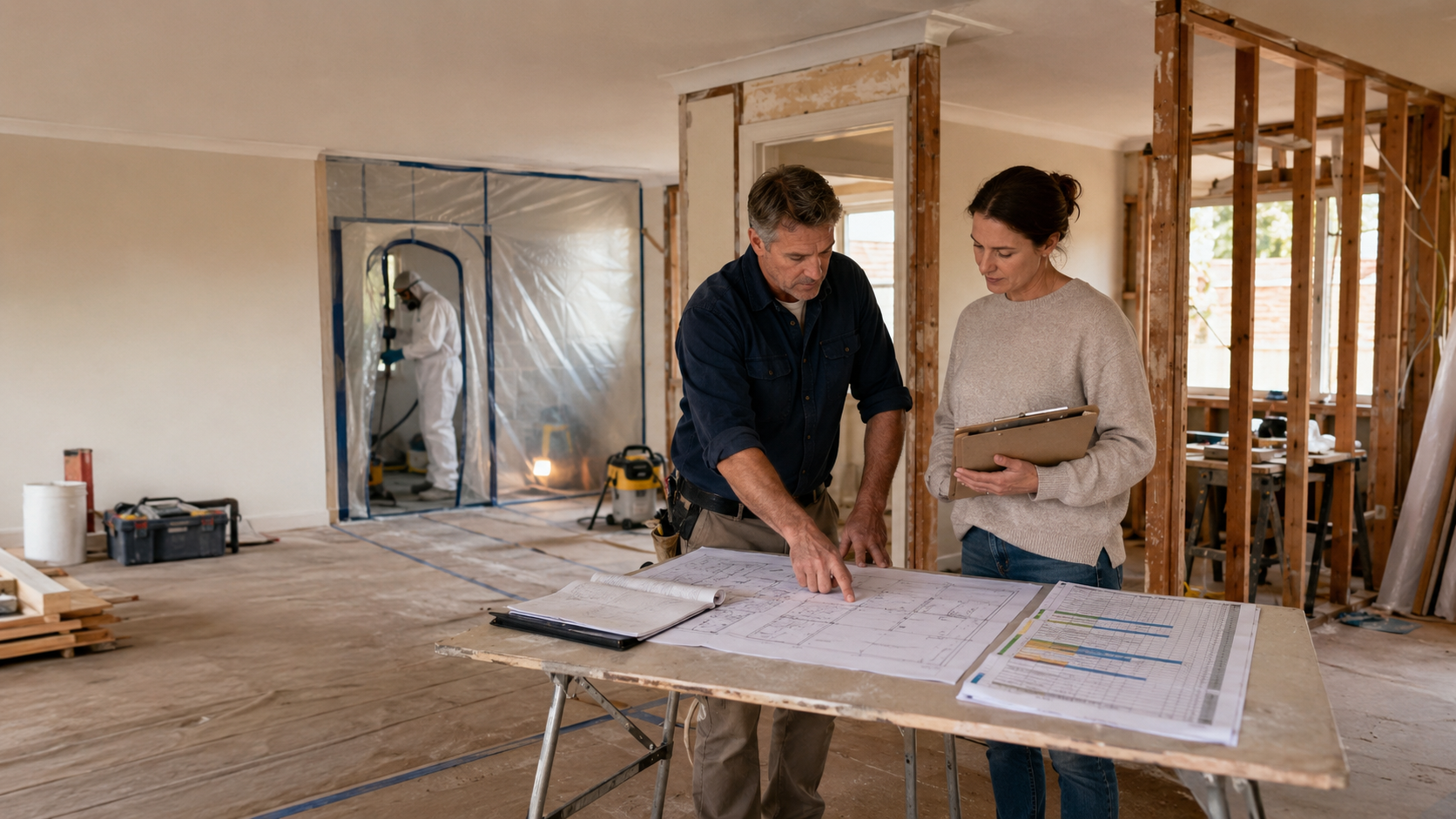
Here’s the reframe that changes everything: asbestos removal isn’t an emergency that derails your renovation. It’s a stage gate that belongs at the very front of your project plan, before demolition, before framing, before a single trade sets foot on site with a crowbar. Too often, though, we convince ourselves that the potential patient is not sick until we run some X-rays, and so we skip this job until later. It’s never cheaper later.
Think of it in project management terms. A stage-gate or critical path approach means each phase only starts once the previous phase is certifiably complete – not “probably fine,” not “the removalist reckons it’s okay,” but formally signed off. Applied to a renovation with hazardous materials on site, that means:
-
Phase Zero: hazardous materials survey, licensed removal, clearance certificate
-
Phase One: demolition and structural work
-
Phase Two: rough-in trades (electrical, plumbing, HVAC)
-
Phase Three: fit-out and finishes
No phase after Zero begins until the clearance certificate exists. Not “the removal team said it’s fine” – an actual document. This is where a lot of owner-builders lose weeks, because they book demolition and abatement in the same week, assuming they’ll run back-to-back. They rarely do. Lab turnaround, removalist scheduling, and assessor availability all have their own lead times, and none of them compress just because your builder is waiting.
Understand the licensing split before you touch anything
In New South Wales, a clear legal distinction between friable and non-friable asbestos is drawn, and a clear distinction about who the law says can remove each. If the asbestos-containing material is friable – crumbly, or can be broken down by hand into a powder – it doesn’t matter you’re not in business: the law requires a Class A licence for removal. That’s the end of the story. No owner-builder is exempted. Non-friable asbestos, as found in most bonded fibro products, becomes subject to a removals licence only if the quantity exceeds 10 square metres.
Do the sums on a typical renovation and DIY removal is just not in the picture. The asbestos you find in a single bathroom’s worth of fibro wall lining, a garage roof, or in old under-house applications, may well exceed that 10 square metre threshold alone. Then, add in the rules of the regulator for 5 days’ advance notification of licensed removal work, and it’s a licensed, notified SafeWork process from the get-go that you’re looking at, not a Saturday morning clean-up of a few offcuts.
So, the best play for your project at this point is to hand the whole thing to a licensed local specialist in Asbestos Removal Sydney rather than take on the hassle yourself. They’ll already know the wet-methods removal techniques, work under negative air pressure containment systems, and use HEPA filtration in compliance with the WorkSafe Code of Practice, and they’ll handle the SafeWork notification and removal clearance certificates. Just remember that if you take the low quote from the operator who’s not set up legally, it is you, the owner, who will get a costlier surprise when their waste tracing back to your site gets detected in a rogue dump and the stop-work order with the fines shows up on your letterbox.
Budget for the discovery, not just the removal
Many home renovation insurance policies specifically exclude contamination claims, including testing, removal, air monitoring, and waste disposal. It’s all on you. Build in a contingency reserve of at least 10 to 20% of your total renovation budget specifically for hazardous material surprises. Not general contingency – a dedicated line item that you don’t touch unless testing comes back positive.
Because the costs don’t stop at the removalist’s invoice. Waste from an asbestos job can’t be mixed with your general renovation skip. It has to be double-wrapped, clearly labelled, transported separately, and taken to an EPA-licensed waste facility, with waste-tracking documentation to prove it got there. That’s a separate transport booking, a separate disposal fee, and in some cases a separate delay if the nearest licensed facility has limited intake windows. None of this is optional, and none of it is cheap, but all of it is predictable if you’ve planned for it from the start.
Keep dust containment in the plan, not just the removal phase
Many people believe that asbestos containment is complete once the removalist is finished. This is not the case, especially if the space that needs work is connected to the rest of the house i.e. a shared wall, ceiling, or duct. Negative air pressure containment isolates the work area during removal to prevent fibres from moving into occupied parts of the structure, but the cleanup standard (HEPA vacuuming, wipe-downs, possible air monitoring) should occur between the removal and construction phases, not be treated as a “check the box” five minutes after you leave job-site.
This becomes even more critical if the renovation is phased over time while the house is still occupied. Dust barriers, sealed doorways, and possibly controlled airflow, in that scenario, should all be built into the trade schedule, not as an afterthought when the jobsite superintendent realizes he forgot to tell anyone to install them. Make it part of your critical path the same way you would a plumbing rough-in or electrical sign-off.
Factor in heritage approvals and council timelines
Many older Sydney homes are located within heritage conservation areas, and while this can be a blessing for the streetscape, it also comes with its fair share of red tape. More than you probably realize when you first sit down to write your ideal renovation timeline.
Demolition and removal of waste are both development applications (DA) in a heritage zone, and both come with 60-day determination periods. If you or your builder isn’t across this extra layer of fine print, it’s a very easy way for the project to be stalled for two months before you’ve even pulled an interior wall down.
If you’re in a heritage area, get the council conversation started early, ideally at the same time you’re booking the hazardous materials survey. Discovering asbestos in a heritage-zoned roof, for example, might mean removal approval and demolition approval are two entirely separate applications with two entirely separate timelines. Sequencing these badly is one of the quieter ways a renovation stalls for months without anyone quite understanding why.
Book the clearance inspection when you book the removal
Here’s the detail that messes up more projects than almost any other: the gap between “removal is finished” and “the next trade can start” is where renovations go to die. It happens because well-meaning homeowners book the removalist, wait for the job to finish, and only then start calling around for a clearance assessor – who might be booked out for a week or two.
Book both at the same time. When you engage your licensed removalist, ask them who’s doing the clearance inspection and lock that appointment in alongside the removal date. A clearance certificate requires visual inspection and, in the case of friable material, air monitoring, before anyone can legally say the site is safe for trades or occupants to re-enter. Treat this booking with the same seriousness as booking your framer or electrician, because until it’s issued, your entire project is on hold whether you feel like it is or not.
Re-verify before you close anything in
One good habit to learn from commercial construction: before you close in a wall, lay flooring, or install cabinetry, do a final re-verify that the zone is indeed clean. It seems extreme for a house reno, but the math of costs is all one way. Catching a missed pocket of contaminated material at a stage gate costs you a delay. Catching it after the plasterboard is up and the tiler has started costs you a demolition, a second removal job, and a second round of finishes – on top of whatever trade time you’ve already paid for.
Keep a written record
After removal is completed, you must keep a written record of what asbestos was found, where it was located, when it was removed, and who removed it. This is not just paperwork – it protects you on resale as buyers and their solicitors will increasingly demand this level of traceability. It also saves you money on every subsequent reno, as the removing contractor will give you re-entry certifying documentation for the site. This proves the due diligence and duty of care that NSW WHS legislation places on owner-builders engaging contractors and controlling a site.
The discovery of asbestos during the renovation process of an older Sydney home is psychologically devastating for many owners. But it isn’t the end of the world or your budget if you do three things. Treat testing, removal, and retesting as three separate gated phases. Budget for proper asbestos removal. And keep every other trade off-site between removal and re-testing phases. The renos need to be sequenced, so the fibro removal contractor is the first person on-site and the vinyl layer is the last. Do that and you’ll lose a couple of weeks on your planning. Fail to, and you’ll lose half a year on your schedule and often twice the price on your budget.